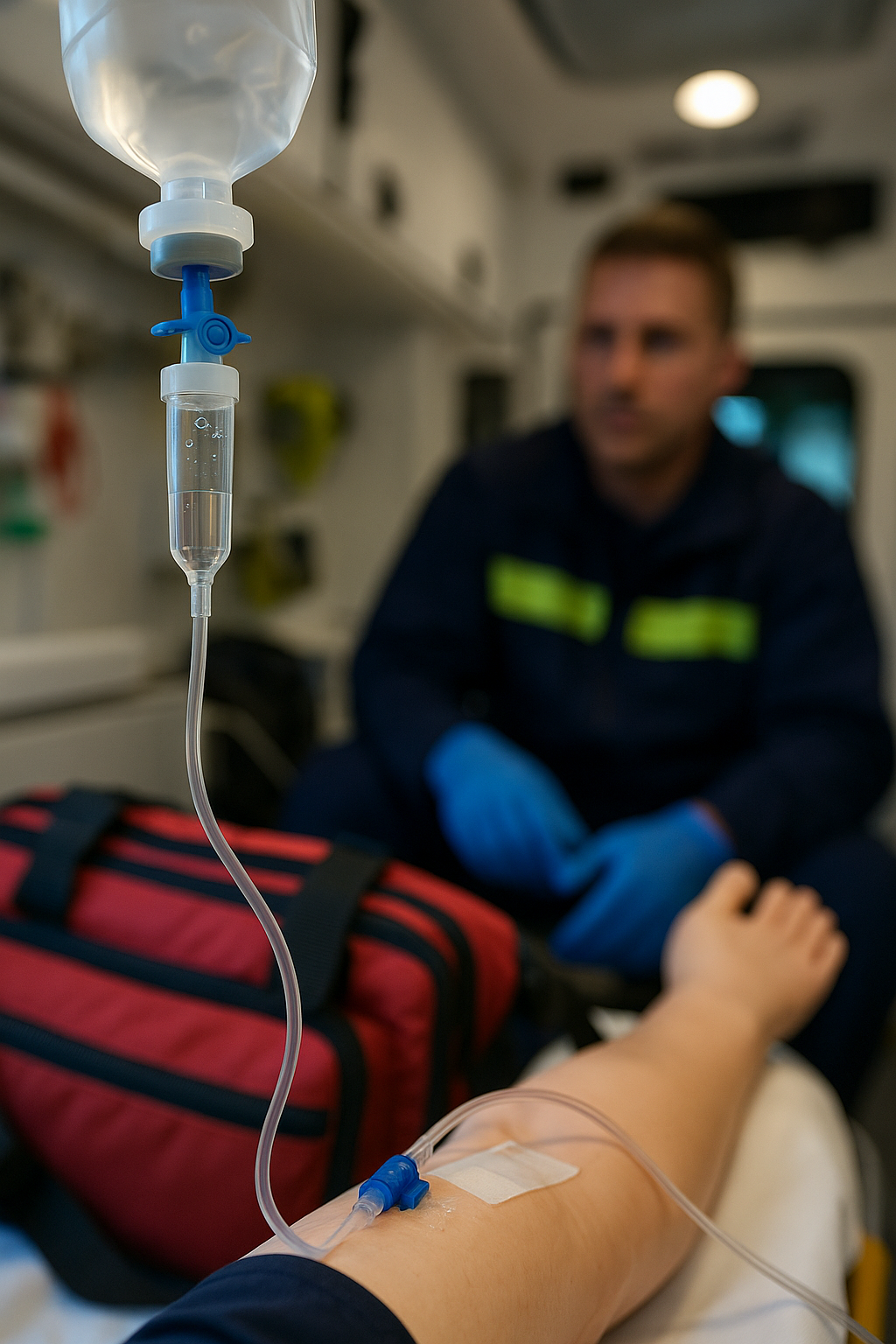
Intravenous therapy in EMS is a cornerstone of prehospital care. Whether you’re stabilizing a trauma victim, correcting hypovolemia, or delivering life-saving medications en route to the hospital, mastering IV therapy can make all the difference. For new EMTs and seasoned paramedics alike, understanding the intricacies of IV access and fluid management isn’t only essential but also mission-critical.
In this article, we’ll break down key facts about intravenous therapy in EMS that every provider should understand. From field applications to patient safety, we’ll explore the best practices, protocols, and tools of the trade.
Why Intravenous Therapy in EMS Matters
First and foremost, intravenous therapy in EMS provides a rapid route for fluid resuscitation and the administration of medications. In emergencies, seconds matter. Oral routes are often impractical, and intramuscular routes may be too slow or unpredictable. IV access allows for almost immediate systemic effects.
Moreover, EMS providers often initiate care long before patients arrive at the hospital. Establishing an IV in the field can mean the difference between a stable patient and one who is deteriorating by the time they reach the ER doors.
Common Indications for IV Therapy in EMS
Understanding when to initiate IV therapy in EMS is just as important as knowing how to do so. The most common field indications include:
-
Hypovolemia or shock – Fluid replacement with normal saline or lactated Ringer’s can temporarily stabilize perfusion.
-
Cardiac emergencies – Medications like epinephrine, amiodarone, or atropine require IV administration.
-
Seizures or altered mental status – IV access is vital for giving dextrose, benzodiazepines, or naloxone.
-
Trauma – IV access is often initiated for potential fluid or blood product administration, especially when hypotension is present.
-
Pain management – Medications such as fentanyl or ketorolac are frequently given intravenously for rapid relief.
Even in non-critical patients, IV access may be necessary for diagnostic purposes or procedures upon hospital admission.
Choosing the Right IV Site and Catheter
Site selection is a vital skill. EMS providers should aim for the largest, most accessible vein possible—commonly the antecubital fossa or the dorsal hand veins. In some cases, the external jugular may be used for rapid access.
When selecting a catheter size, the rule of thumb is: the bigger, the better—especially in trauma. A 16- or 18-gauge catheter allows for faster fluid resuscitation, while a 20- or 22-gauge may suffice for medication delivery in stable patients.
However, remember that large-bore catheters are more challenging to place, and failed attempts can delay care. Knowing your patient’s needs and your own skill level is essential for making the right call.
Types of Fluids Used in EMS
When it comes to intravenous therapy in EMS, the go-to fluids are crystalloids, specifically:
-
Normal Saline (0.9% NaCl) – This is the most commonly used fluid for volume replacement.
-
Lactated Ringer’s (LR) – Often used in trauma, LR more closely mimics the body’s plasma and can be more effective for large-volume resuscitation.
Hypertonic solutions and blood products are typically not administered in the prehospital setting unless part of a specialized response team or protocol. However, it’s crucial to understand how different fluids affect electrolyte balance and intravascular volume so you can anticipate complications.
Complications of IV Therapy in the Field
Despite the benefits, intravenous therapy in EMS is not without risks. Some common complications include:
-
Infiltration – When fluid leaks into surrounding tissue due to catheter dislodgement or vein rupture.
-
Phlebitis – Inflammation of the vein, often due to poor technique or irritating medications.
-
Air embolism – Rare but deadly; occurs if air enters the IV system and reaches circulation.
-
Infection – Though less common in short-term field use, improper technique can introduce pathogens.
Providers must always follow aseptic technique and monitor IV sites for signs of complications during transport.
Alternatives to Traditional IV Access
Sometimes, traditional peripheral IV access just isn’t possible, especially in pediatric patients, hypovolemic shock cases, or cardiac arrests. That’s where intraosseous (IO) access shines.
IO devices allow rapid vascular access through the bone marrow and have become a standard backup option in many EMS systems. The tibia and humeral head are common IO sites.
Although IO access is associated with higher discomfort and rare complications, such as osteomyelitis, the speed and reliability make it a game-changer when time is short.
Medication Administration via IV in EMS
Intravenous therapy in EMS isn’t just about fluids—it’s the primary route for many emergency medications. These include:
-
Epinephrine – For cardiac arrest and anaphylaxis.
-
Amiodarone and Lidocaine – For ventricular arrhythmias.
-
Dextrose – For hypoglycemia.
-
Ketamine, Fentanyl, Morphine – For sedation and pain management.
-
Ondansetron (Zofran) – For nausea and vomiting.
Each drug has its own administration rate, dilution requirements, and contraindications. A thorough understanding of your EMS protocols and drug formulary is critical.
Documentation and Protocol Compliance
In addition to technical skills, providers must also ensure proper documentation of IV therapy in EMS. That includes:
-
Time of insertion
-
Site and gauge
-
Type and volume of fluids administered
-
Medications given via the IV route
-
Patient response and complications
Not only does this support patient care continuity, but it also protects providers from legal liability and ensures QA/QI processes are followed.
Field Tips for Better IV Success
Mastery of intravenous therapy in EMS takes time, but here are some battle-tested tips:
-
Warm the patient – Cold extremities lead to vasoconstriction, making veins harder to find.
-
Use a tourniquet properly – Tight enough to occlude venous flow but not arterial.
-
Anchor the vein – Prevent rolling by applying skin traction.
-
Visualize, then palpate – Feel is often more reliable than sight in dimly lit environments.
-
Don’t dig – If you miss, pull out and try again. Blind probing increases complications.
Lastly, practice makes perfect. Utilizing training dummies, cadaver labs, and simulations can enhance your IV confidence.
Future Innovations in Prehospital IV Therapy
Technology continues to enhance the way we perform IV therapy in EMS. Emerging tools include:
-
Vein-finding devices – Near-infrared technology helps visualize veins in patients with difficult veins.
-
IV ultrasound – Though rare in the field, more EMS systems are exploring this tool for guided access.
-
Pre-filled medication syringes – Reduce errors and speed up drug administration.
-
Smart IV pumps – Although mostly in interfacility transfers, these allow more accurate drug dosing.
With ongoing advances, EMS providers will be better equipped than ever to deliver fast and effective care.
Training and Continuing Education
No discussion about intravenous therapy in EMS would be complete without highlighting the importance of training. IV access is considered a basic skill, but one that requires constant refinement.
Regular training in:
-
Anatomy and physiology
-
Fluid pharmacology
-
Patient assessment
-
Advanced vascular access (e.g., IO)
-
Scenario-based practice
…ensures both new providers and veterans stay sharp.
At Texas Rescue Med, we emphasize hands-on IV skills training in our EMT and Paramedic programs. From the fundamentals to advanced protocols, we prepare our students for real-world situations with high-fidelity simulations and experienced instructors.
Conclusion: Why IV Therapy Still Matters in EMS
Intravenous therapy in EMS remains one of the most vital tools in our arsenal. While it’s easy to view it as routine, proper technique, sound clinical judgment, and continuous education can elevate this skill from ordinary to extraordinary.
Whether you’re stabilizing a critical patient or preparing someone for hospital care, mastering the art and science of IV therapy is a key component of what defines a great EMS provider.
Take the Next Step
Are you ready to refine your IV therapy skills and become a stronger EMS professional? Visit www.texasrescuemed.com to explore our EMT and Paramedic training programs, sign up for continuing education, and apply today. Let’s take your career—and your care—to the next level.
Sources:
-
American Heart Association (AHA) ACLS Provider Manual, 2020 Edition.
-
National Association of EMS Educators (NAEMSE) IV Therapy Curriculum Guide.
-
“Prehospital Emergency Care,” 11th Edition, Mistovich & Karren.
-
National Registry of EMTs (NREMT) – Scope of Practice Model, 2021.
Related Articles:
Life on the Line: How EMS Professionals Recognize and Treat Shock in Emergencies
EMTs vs. Paramedics: Understanding the Key Differences in EMS Roles
Visit us on Facebook!
Visit us on Instagram!

One Comment