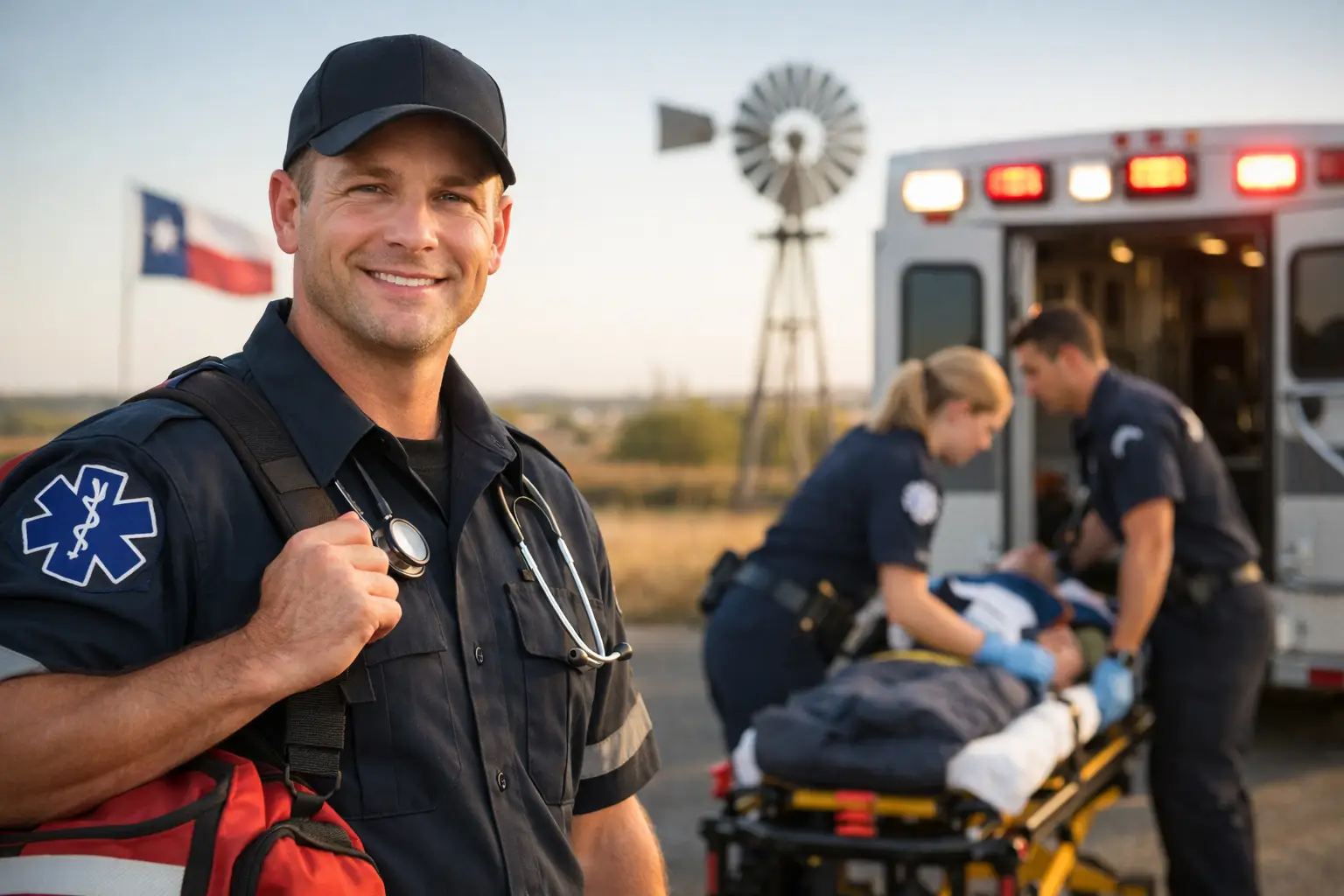
A lot of people decide they want to work in emergency care after a single moment – helping at a crash scene, watching first responders in action, or realizing they want a career that matters on day one. If you are asking how to become an EMT in Texas, the path is straightforward, but it does require the right training, the right sequence, and a clear understanding of state and national requirements.
Texas is a strong place to start an EMS career because demand remains steady across cities, suburbs, and rural communities. EMT training can open the door to ambulance services, fire departments, industrial safety roles, event medicine, and future advancement into AEMT or paramedic education. For many students, it is also one of the fastest ways to enter healthcare in a meaningful, hands-on role.
How to become an EMT in Texas: the basic path
At a high level, the process looks like this: complete an approved EMT education program, develop and verify your practical skills, pass the National Registry exam process, and meet Texas licensing requirements through the Texas Department of State Health Services.
That sounds simple, but each step matters. If you choose a program that is not aligned with current standards, or one that does not prepare you well for both the cognitive exam and patient care in the field, the process gets harder than it needs to be. Good training should do more than help you check boxes. It should prepare you to perform under pressure.
Meet the basic eligibility requirements
Before enrolling, make sure you can meet the usual entry expectations for EMT training in Texas. Specific school policies can vary, but most students should expect to need a high school diploma or GED, the ability to complete required coursework and skills practice, and the ability to meet health, background, or documentation requirements tied to clinical or field participation.
Age can vary depending on the program and licensing timeline, so this is one area where details matter. Some students begin training before they fully meet every licensure milestone, while others wait until they can move straight from class to testing and certification. If you are balancing work or family, it is worth asking not just whether you can enroll, but whether the schedule is realistic for you.
Choose an approved EMT training program
This is the most important decision in the process. Your EMT course needs to prepare you for the National Registry of Emergency Medical Technicians standards and Texas requirements, while also giving you enough hands-on practice to feel ready in real patient situations.
In Texas, many adult learners prefer hybrid programs because they offer more flexibility. That can be a major advantage if you are working full time, covering shifts, or managing family responsibilities. The trade-off is that flexibility only helps if the program is well organized. Online coursework should be structured, instructor support should be available, and in-person skills sessions should be purposeful rather than rushed.
A strong EMT program should cover patient assessment, airway management, trauma care, medical emergencies, cardiology basics, obstetrics, and operations. It should also prepare you for the pace and expectations of EMS work, not just the test. That real-world focus matters. Passing an exam is one milestone. Earning trust on scene is another.
For students looking for a flexible but serious route, Texas Rescue Med reflects the kind of training model many Texas learners need – compliant, career-focused education with online and hybrid options built around certification readiness and practical skill development.
Complete the classroom, skills, and clinical requirements
EMT education is not only academic. You will study medical terminology, anatomy, patient care principles, and EMS operations, but you will also need to demonstrate hands-on competency. That means learning how to assess patients, take vital signs, manage bleeding, provide oxygen, assist with airway interventions, and respond appropriately in trauma and medical scenarios.
Depending on the program, you may also complete clinical or field requirements. These experiences matter because they help turn theory into judgment. Reading about respiratory distress is one thing. Seeing it in real time, while managing your own nerves and staying focused, is different.
This part of training can feel demanding, especially for students new to healthcare. That is normal. EMT education should challenge you. The goal is not to make you comfortable with every scenario overnight. The goal is to build competence, habits, and confidence step by step.
Pass the National Registry exam process
After completing your EMT course, the next major step is National Registry testing. In most cases, Texas EMT candidates pursue National Registry certification as part of the licensure pathway. This usually includes the cognitive exam and may include psychomotor or skills verification requirements depending on current standards and program processes.
The cognitive exam tests whether you can apply knowledge, not just memorize it. Students often underestimate this part. You need to know patient assessment priorities, when to intervene, what is most dangerous, and how to think like an entry-level provider. If your training has been strong, the exam should feel rigorous but fair.
Preparation matters here. Review consistently, practice scenario-based thinking, and do not wait until the last week to fill knowledge gaps. Adult learners who have been out of school for a while sometimes worry about testing, but many do very well when the program is organized and the study plan is realistic.
Apply for Texas EMT certification
Once you have completed the required education and National Registry steps, you can move into the Texas certification process. Texas regulates EMS personnel through the Department of State Health Services. Requirements can change, so students should always verify current application steps, fees, and documentation requirements.
This stage may involve submitting proof of course completion, exam results, identification, and other required materials. If there are background review issues or missing documents, your timeline can slow down. That is why organization matters from the beginning. Keep copies of everything and respond quickly to any requests.
If you are wondering how to become an EMT in Texas as quickly as possible, this is where many delays happen. Usually it is not because the path is unclear. It is because paperwork, scheduling, or exam readiness was treated as an afterthought.
How long does it take?
For many students, EMT training can be completed in a matter of months, though the exact timeline depends on the program format, your availability, and how quickly you complete testing and state application steps. A full-time, highly structured schedule may move faster. A hybrid schedule may fit life better but take a little longer.
Neither option is automatically better. The right timeline is the one that lets you finish strong. Rushing through training while juggling work and family can backfire if it hurts comprehension or exam performance. On the other hand, waiting too long between course completion and testing can make it easier to forget key material.
What does it cost?
Cost varies by school, and comparing tuition alone can be misleading. Some programs look affordable at first, then add separate charges for books, uniforms, testing prep, lab fees, or skills sessions. Others offer more transparent pricing.
When evaluating cost, ask what is actually included and what support you receive. A cheaper course is not a better value if it leaves you underprepared for National Registry testing or short on practical experience. Good EMT education should help you move efficiently toward certification and employment.
What employers want from new EMTs
Certification gets you qualified to apply, but employability depends on more than that. EMS employers want new EMTs who show up prepared, communicate clearly, stay calm, accept feedback, and work well in a team. Technical skills matter, but so do reliability and judgment.
This is one reason field-oriented training matters so much. New EMTs do not need to know everything. They do need to arrive with a solid foundation, respect for the role, and the ability to keep learning under pressure. The best programs understand that certification is the start of professional development, not the end.
Is EMT the right fit for you?
EMT work is rewarding, but it is not easy. You will encounter stress, irregular hours, physically demanding tasks, and moments that stay with you long after the shift ends. At the same time, few entry-level healthcare roles offer this level of responsibility, teamwork, and direct impact.
If you are mission-driven, able to stay composed in urgent situations, and serious about serving your community, EMT training can be a powerful first step. It can also create long-term options in fire service, advanced EMS practice, emergency management, and broader healthcare careers.
The strongest students are not always the ones with the most medical background. Often, they are the ones who commit fully, ask questions early, and choose training built for real readiness. If this career is calling you, start with a program that respects your time, meets Texas standards, and prepares you to care for people on their worst day. That is where becoming a lifesaver truly begins.