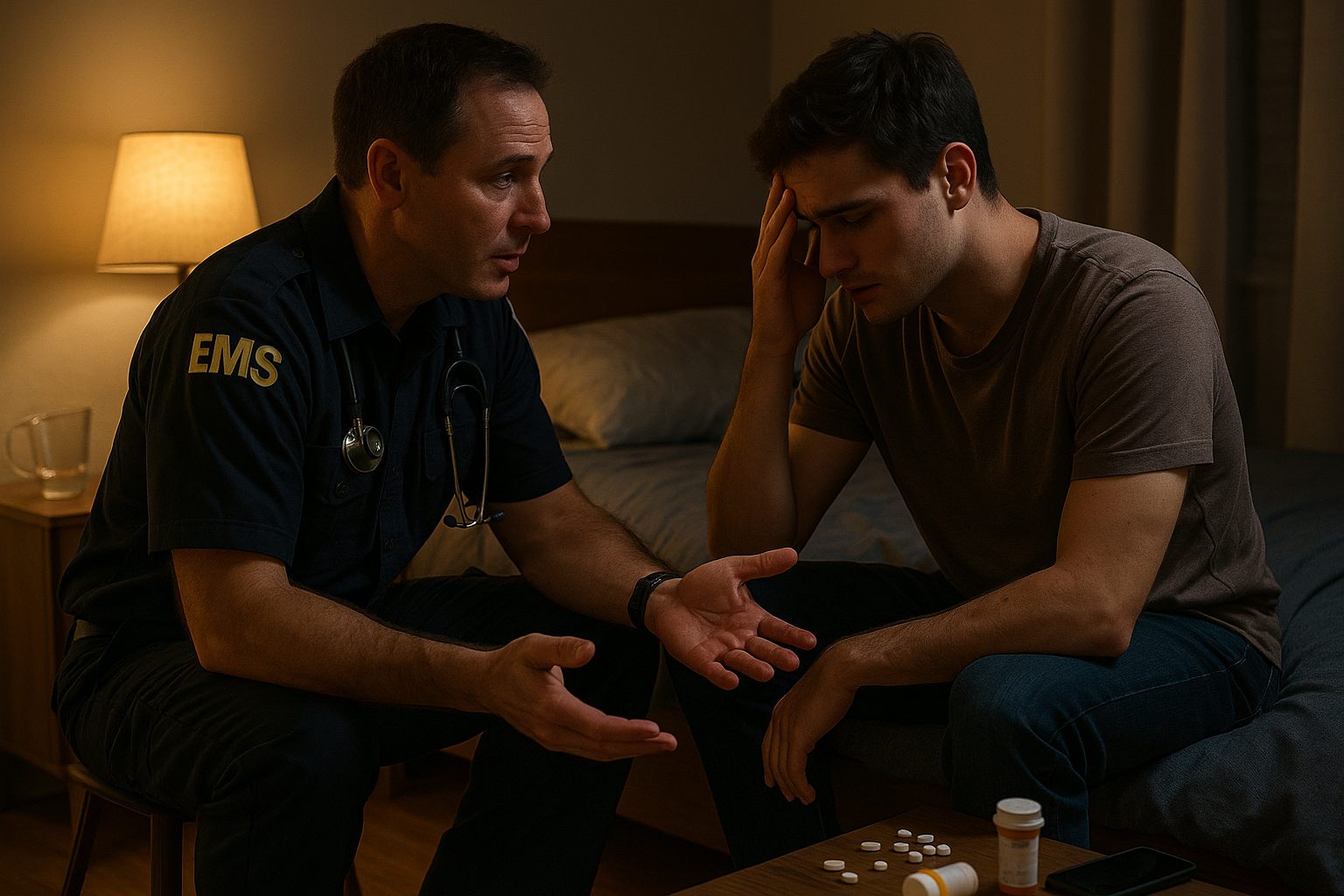
In EMS, there’s no such thing as a “routine” call. Every dispatch has the potential to shift from a simple transport to a life-or-death crisis. When it comes to EMS and mental health: recognizing suicidal ideation, the stakes are incredibly high. Recognizing the subtle — and sometimes not-so-subtle — signs of suicidal thoughts is essential for effective intervention. It’s not just about providing physical care; it’s about protecting a patient’s most precious asset — their life.
This article will walk through the importance of awareness, how to spot warning signs, effective communication strategies, and the steps to take in the field to ensure safety.
Understanding the Link Between EMS and Mental Health
EMS providers are often the first point of contact for individuals in mental health crises. According to the CDC, suicide is among the leading causes of death in the United States, claiming over 49,000 lives in 2022 alone . The presence of EMS during these moments can be the deciding factor between tragedy and survival.
Because EMS professionals operate in uncontrolled environments, they must balance patient safety, scene safety, and the urgent need for intervention. The ability to recognize suicidal ideation early can help prevent self-harm and connect patients with the resources they need.
Why Recognizing Suicidal Ideation Matters in EMS
When someone is actively contemplating suicide, the window for effective intervention can be extremely short. While hospital staff can monitor and manage patients over hours or days, EMS providers may only have minutes. Furthermore, suicidal ideation can be masked by physical complaints or substance use, requiring a sharp eye and active listening skills.
Failing to recognize the signs could mean:
- The patient is released without a proper mental health evaluation.
- The opportunity for life-saving intervention is missed.
- The patient may harm themselves immediately after EMS departure.
In short, early recognition is critical.
Common Warning Signs of Suicidal Ideation
Recognizing suicidal ideation involves paying attention to verbal, behavioral, and situational cues. Some are obvious; others are subtle.
1. Verbal Indicators
Patients may directly or indirectly express thoughts of suicide. This could be overt, like “I want to end my life,” or more veiled, such as:
- “I don’t see the point anymore.”
- “Everyone would be better off without me.”
- “I just want the pain to stop.”
As EMS providers, it’s important not to dismiss these as mere expressions of frustration. They warrant follow-up questions.
2. Behavioral Cues
Changes in behavior may signal acute distress:
- Withdrawal from family and friends
- Giving away personal belongings
- Reckless or self-destructive actions (e.g., reckless driving, substance abuse)
- Sudden calmness after a period of agitation (this can indicate a resolved decision to act)
3. Situational Red Flags
Consider the patient’s environment and life events:
- Recent loss of a loved one
- Job loss or financial crisis
- History of trauma or abuse
- Access to lethal means (firearms, medications, knives)
Scene Safety Considerations
When responding to mental health calls, scene safety must be a top priority. Patients experiencing suicidal ideation may be armed or in a volatile emotional state.
Best practices include:
- Requesting law enforcement assistance when weapons or violence are suspected.
- Maintaining a safe distance and positioning yourself near an exit.
- Using calm, non-threatening body language.
- Avoiding sudden movements or aggressive tones.
Communication Strategies for EMS Providers
Talking about suicide is uncomfortable for many, but as EMS providers, we must approach it directly yet compassionately. Research shows that asking about suicidal thoughts does not “plant the idea” in someone’s mind; instead, it opens the door to help .
Effective communication techniques:
- Ask Directly and Clearly
- “Are you thinking about killing yourself?”
- “Have you been feeling hopeless or like you want to die?”
- Listen Without Judgment
Show empathy. Avoid minimizing the person’s feelings or offering quick fixes. - Use Open-Ended Questions
Encourage the patient to share their thoughts: “Tell me what’s been going on lately.” - Validate Their Feelings
Phrases like “That sounds really difficult” can build trust.
Clinical Assessment Tools in the Field
While EMS providers don’t perform formal psychiatric evaluations, simple screening tools can help guide decisions. One example is the Columbia-Suicide Severity Rating Scale (C-SSRS), which includes questions about suicidal thoughts, plans, and past behaviors.
Example rapid assessment questions:
- Have you wished you were dead or could go to sleep and not wake up?
- Have you had any thoughts of killing yourself?
- Have you started to work out or prepared to do anything to end your life?
If the patient answers “yes” to any of these, they should be considered at risk and transported for further evaluation.
Documentation Is Critical
Accurate documentation of suicidal ideation is essential for continuity of care and legal protection. Include:
- Patient’s exact words
- Observed behaviors
- Questions asked and responses given
- Scene conditions and risk factors identified
- Interventions performed and patient’s reaction
Interventions EMS Can Provide
While EMS providers cannot treat the underlying cause of suicidal ideation in the field, there are crucial steps we can take:
- Ensure Immediate Safety
Remove any weapons or lethal means from the patient’s reach. - Engage Crisis Resources
Contact crisis lines, mental health mobile crisis teams, or law enforcement partners. - Transport to an Appropriate Facility
This may be an emergency department with psychiatric services or a dedicated behavioral health facility. - Provide Supportive Care
Sometimes, simply being present and listening is the first step in preventing a suicide attempt.
Caring for the EMS Provider: Emotional Impact
Responding to suicidal patients can take a heavy toll on EMS professionals. Exposure to repeated traumatic events increases the risk of burnout, compassion fatigue, and even provider suicidal ideation. According to a study in Prehospital Emergency Care, EMS providers have a higher rate of suicidal thoughts compared to the general population .
Self-care strategies include:
- Accessing peer support programs
- Using employee assistance programs (EAP)
- Seeking professional counseling
- Maintaining healthy routines outside of work
Real-World Scenario
Imagine you’re dispatched to a “wellness check.” On arrival, you find a 32-year-old male sitting on his couch, a half-empty bottle of whiskey on the table, and several pill bottles nearby. He tells you, “I’m just tired of everything.”
Red flags identified:
- Verbal statement indicating hopelessness
- Access to lethal means (medications, alcohol)
- Isolation
EMS actions:
- Ask direct questions about suicidal thoughts.
- Secure medications and alcohol.
- Engage local crisis intervention team.
- Document patient’s words and actions.
- Transport to an ED for psychiatric evaluation.
This illustrates how recognizing and acting upon subtle cues can shift the outcome from tragedy to treatment.
Training for EMS and Mental Health Response
Ongoing education is essential for improving recognition and response to suicidal ideation. Recommended training includes:
- Crisis Intervention Team (CIT) Training
- Mental Health First Aid
- QPR (Question, Persuade, Refer) Suicide Prevention
- Scenario-based training with role-playing for communication skills
Conclusion: The EMS Role in Suicide Prevention
In the realm of EMS and mental health: recognizing suicidal ideation, awareness and action save lives. EMS providers must be prepared to see beyond the immediate physical presentation and consider the patient’s mental state. By recognizing warning signs, engaging in compassionate communication, ensuring safety, and connecting patients to resources, EMS plays a pivotal role in suicide prevention.
The next time you’re on scene, remember — your words, your presence, and your actions may be the last lifeline a patient has.
If you or someone you know is struggling with suicidal thoughts, call or text 988, the Suicide and Crisis Lifeline, or use the webchat at 988lifeline.org.
References:
-
- Centers for Disease Control and Prevention. (2023). Suicide Data and Statistics. Retrieved from https://www.cdc.gov/suicide
- National Institute of Mental Health. (2023). Ask Suicide-Screening Questions (ASQ) Toolkit. Retrieved from https://www.nimh.nih.gov
- Stanley IH, Hom MA, Joiner TE. A systematic review of suicidal thoughts and behaviors among police officers, firefighters, EMTs, and paramedics. Clin Psychol Rev. 2016 Mar;44:25-44. doi: 10.1016/j.cpr.2015.12.002. Epub 2015 Dec 12. PMID: 26719976.
Call to Action:
To learn more about EMS mental health response and other life-saving skills, visit www.texasrescuemed.com. Explore our EMT and advanced EMS courses, and take the first step toward making a real difference in your community. Apply today — your training could save a life.
Related Articles:
Overcoming the First Responder Hurdles: Top 5 Challenges New EMTs Face and How to Conquer Them
Lifesaving on the Frontier: Top Emergencies Rural EMS Teams Face Every Day

I just wanted to drop by and say how much I appreciate your blog. Your writing style is both engaging and informative, making it a pleasure to read. Looking forward to your future posts!
Normally I do not read article on blogs however I would like to say that this writeup very forced me to try and do so Your writing style has been amazed me Thanks quite great post
Your blog is like a beacon of light in the vast expanse of the internet. Your thoughtful analysis and insightful commentary never fail to leave a lasting impression. Thank you for all that you do.
My brother suggested I might like this website He was totally right This post actually made my day You cannt imagine just how much time I had spent for this information Thanks
I just could not leave your web site before suggesting that I really enjoyed the standard information a person supply to your visitors Is gonna be again steadily in order to check up on new posts
Thank you for the auspicious writeup It in fact was a amusement account it Look advanced to far added agreeable from you However how can we communicate
of course like your website but you have to check the spelling on several of your posts A number of them are rife with spelling issues and I in finding it very troublesome to inform the reality on the other hand I will certainly come back again
Your writing is like a breath of fresh air in the often stale world of online content. Your unique perspective and engaging style set you apart from the crowd. Thank you for sharing your talents with us.
Your blog is a treasure trove of knowledge! I’m constantly amazed by the depth of your insights and the clarity of your writing. Keep up the phenomenal work!
Ive read several just right stuff here Certainly price bookmarking for revisiting I wonder how a lot effort you place to create this kind of great informative website
Nice blog here Also your site loads up fast What host are you using Can I get your affiliate link to your host I wish my web site loaded up as quickly as yours lol
I am not sure where youre getting your info but good topic I needs to spend some time learning much more or understanding more Thanks for magnificent info I was looking for this information for my mission
Usually I do not read article on blogs however I would like to say that this writeup very compelled me to take a look at and do it Your writing style has been amazed me Thank you very nice article
Simply desire to say your article is as surprising The clearness in your post is simply excellent and i could assume you are an expert on this subject Fine with your permission let me to grab your feed to keep up to date with forthcoming post Thanks a million and please carry on the gratifying work
This article is a real eye-opener! Who knew asking someone if theyre thinking about suicide wouldnt plant the idea? I always thought it was like asking if they wanted dessert – the answer is clearly yes! But hey, its good to know that simply listening and not offering quick fixes is the key. And the part about scene safety? Classic – maintain distance, act calm, avoid sudden movements… just like you wouldnt want to startle a charging bull in a rodeo! Definitely a valuable read for anyone in the field, though I hope I never have to actually use any of this stuff. Good luck to all the EMS providers out there – youve got the skills, the compassion, and now the knowledge to handle it all!watermark remove ai